
Perinton Previous Residents by Era
A backward address trail uses different records for different periods. Start with the most recent reliable parcel identifier, then choose the source that reaches the target date. The assessment roll offers a recent ownership snapshot. Directories and newspapers give dated household clues. A map can describe the building and its surroundings. None of these sources alone answers every question about who lived at an address, so label each result by its source and date.
| Source | Years it covers | Where held | What it can show |
|---|---|---|---|
| Perinton final assessment rolls | 2019-2026 links | Town assessment page and office | Recent owner, parcel, location, mailing, and value fields |
| Monroe property report | 2025 final-roll sample; sales history can reach 1996 | County property system | Parcel-specific building and sales clues |
| County deed index | Digital cutoff requires verification; older deeds on microfilm | County Clerk | Parties, legal description, date, and book or page |
| Directories and newspapers | Directories from 1827; Society series 1864-1966 | Library, Historian, and Society | Dated address, household, locality, or event clue |
| Fairport Sanborn maps | 1885-1924 | Perinton Historical Society | Building footprint, use, and street context |
| Permits | Advertised 1988-present | Town GovWell and Building and Codes | Building milestones, not household identity |
For an address from the nineteenth century, begin with a directory, street or house file, newspaper, map, or plat clue before expecting a current assessment record to reach that far back. For a later transaction, begin with the parcel and deed reference, then use the household sources to test who was associated with the address at the time.
Perinton Address Records and Parcels
The Perinton assessment portal information is the current starting point. The Town lists final-roll links for 2019-2026. Record the roll year, property location, owner or mailing name where shown, tax-map parcel ID, and any deed book or page reference. An assessment owner is an ownership lead, not proof that the person lived at the parcel. A mailing address can be elsewhere, and a deed or name change can take months to appear in the assessment system.
Save the parcel ID before leaving the record. It connects the property report, GIS view, and County Clerk trail when street spelling or numbers drift. The County property report can add sales information and building details, but its depth varies by parcel. Keep the situs, or property location, separate from a tax mailing address. That distinction avoids turning tax correspondence into a claim about a household.
Note: A final-roll entry is dated ownership evidence and a parcel reference, not a complete list of people who occupied the address.
Tracing Perinton Previous Residents Through Deeds
The Monroe County historical deed guide uses a liber and page chain. Find the oldest known deed through the address or current owner, read the grantor, grantee, transfer date, and legal description, then search the seller as an earlier grantee. Use the legal description, map or lot reference, acreage, and municipality whenever a name is common or an old instrument lacks a modern street number.
- Collect the current parcel ID, roll date, property location, and displayed deed reference.
- Locate the latest deed in the County Clerk index and record its instrument type, date, parties, legal description, and book or page.
- Search the seller as a grantee to identify the earlier transfer into that person’s name.
- Repeat the process, retaining each older legal description and locality rather than relying on the present street address.
- Move to Clerk microfilm and grantor or grantee indexes when the online record does not reach the needed period.
- Grantor
- The party transferring an interest in the property.
- Grantee
- The party receiving that interest.
- Chain of title
- The ordered sequence of recorded transfers used to follow a legal interest backward.
- Legal description
- The deed’s land description, which can remain useful when a street number changes.
- Liber
- The historical deed book number; the page identifies the image location within that book.
Deed chains can branch. Mortgages, satisfactions, assignments, liens, maps, and subdivision filings may appear between transfers. A family, estate, trust, or entity transfer can also change the title without identifying a new household. Treat a deed party as a title fact and seek a separate dated source before identifying a past resident.
Perinton Address Records at Clerk
The Monroe County Clerk records service is the central route for deeds, mortgages, maps, and related instruments. The Clerk’s own sources give two digital boundaries: its historic deed guide says post-1975 deeds can be searched digitally by address or owner, while the County historian describes online land transactions from February 1984 forward. Verify the current coverage before choosing an online starting year. Pre-1975 deeds use Downtown Filing Office microfilm organized by liber.
Since April 1, 2026, remote guests can search and view IQS index information, while document images require a paid subscription. Public terminals retain no-cost full indexing and images. For a copy, use the Clerk terminal, phone 585-753-1600, mail a request to 39 W Main Street, Room 105, Rochester, NY 14614, or fax 585-753-1650 with a callback number. Ordinary copies are listed at $0.65 a page, with a $1.30 minimum; certified copies are $5 for the first four pages and $1.25 for each additional page.
The Monroe County Clerk records index is the source to consult before placing an order, because it provides the party, date, instrument, and reference details that identify the right copy.
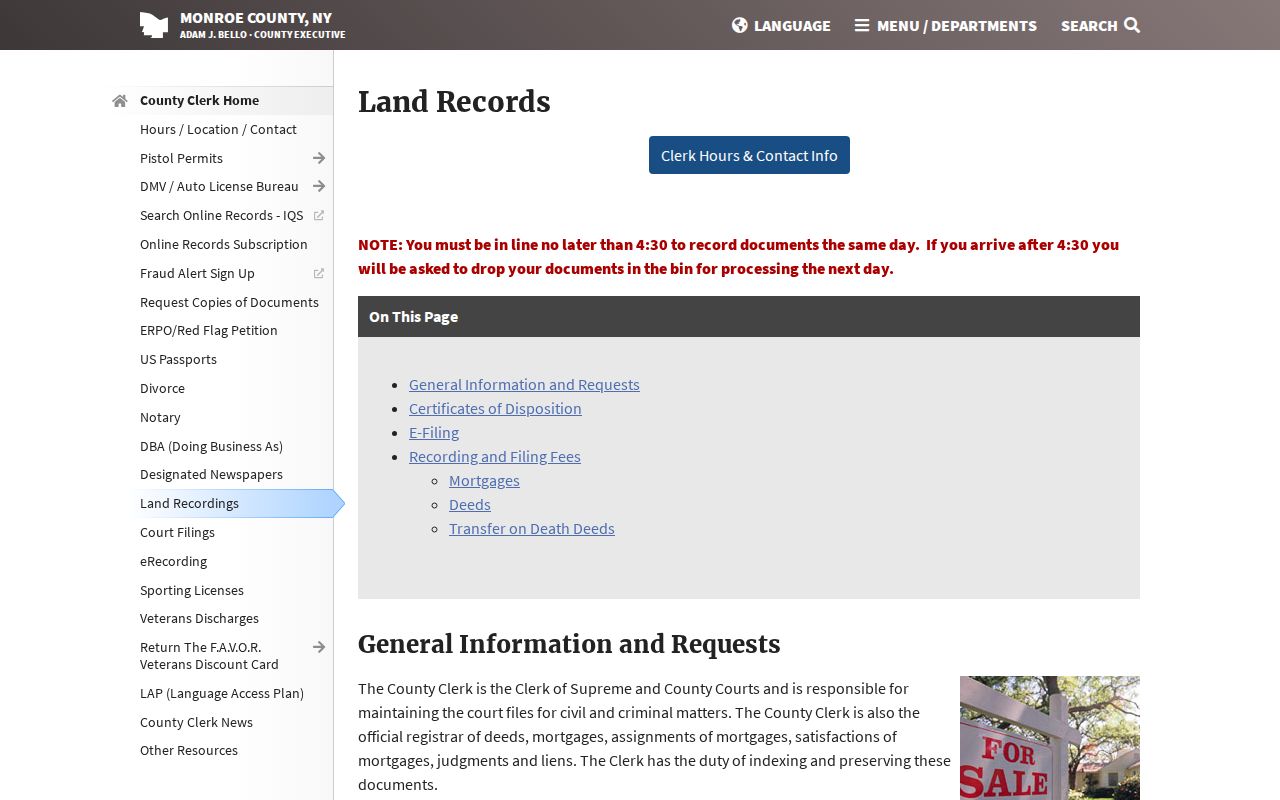
The Clerk index supplies the reference trail, while an image or certified copy must be obtained through the applicable remote, terminal, or copy-request channel.
The County Clerk document-order form lets a requester select Court, Land, or Other and supply the applicable property address, city, state, ZIP, book or page, tax ID, names, and delivery choice. Use it when the index identifies a needed record but the image is not available through the selected access route.
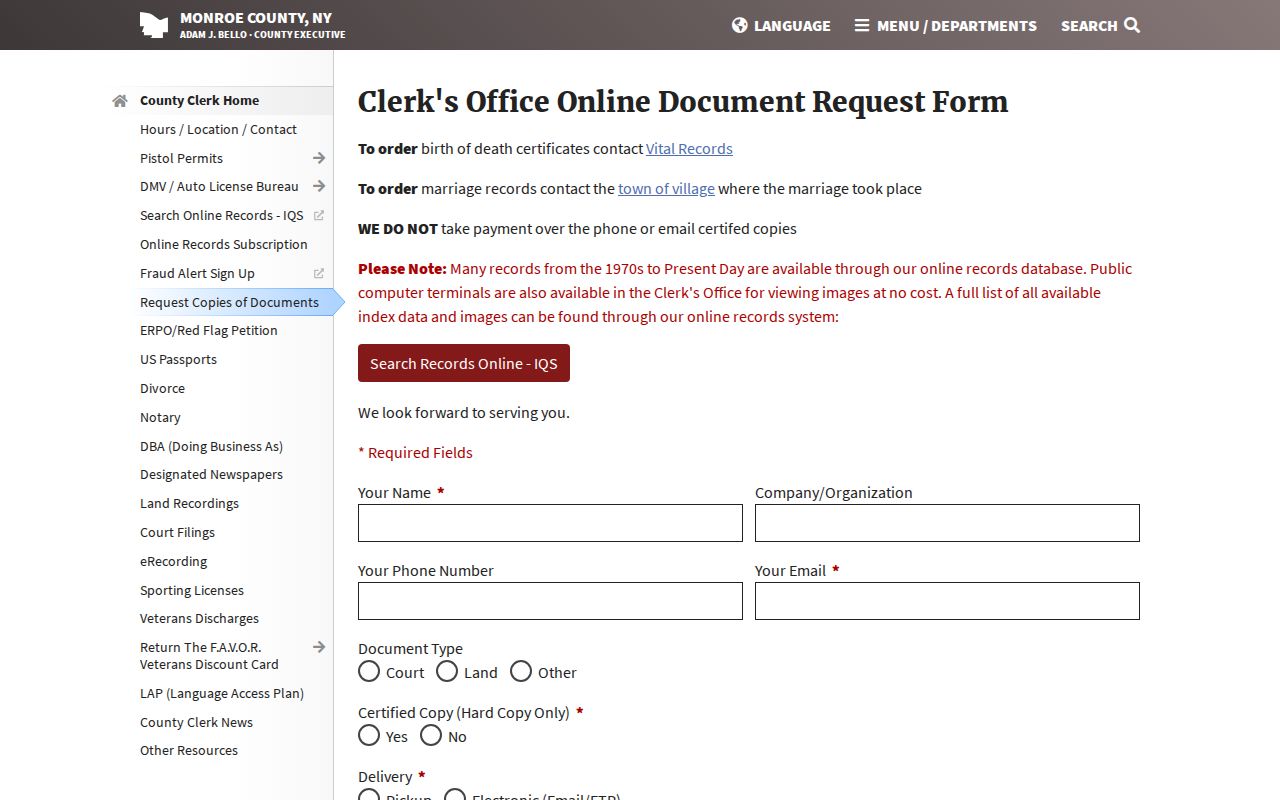
The order form is a copy-request channel, not a substitute for the deed index. Include the most precise information already found so the Clerk can identify the right land record.
Perinton Past Residents in Street Files
Legal ownership is only one layer. Fairport Public Library’s Local History collections include historian street and house files, biographies and obituaries, cemetery records, yearbooks, photographs, and topical material. The Perinton Town Historian maintains files on streets and ownership. These are strong sources for a date-bounded question about a particular address, but the record type should stay clear: an obituary subject, directory occupant, permit applicant, and deed party can be different people.
Ask for a date range, the street spelling, known house number, locality, and any former number. Library staff can direct researchers to local stacks and pamphlet files. In-person and reference-desk help are the practical fallback when a document is not digitized. Pair a house-file clue with a contemporaneous directory, newspaper, map, or deed before stating a continuous household history.
Perinton Address Records and Sanborn Maps
The Perinton Historical Society holds Fairport Sanborn maps for 1885-1924, plus plat and property material from the late 1700s-1850 and architectural surveys. A Sanborn sheet can supply building footprint, use, outbuildings, and its relation to nearby streets. It gives physical context, not a list of occupants. That distinction matters when a directory entry and a deed point to the same address but the structure may have been altered, split, or renumbered.
The Society also lists newspaper articles from 1977-1990, photographs, cemetery tombstones, census material from 1800-1915, and business or residential directories from 1864-1966. Museum hours are listed as Tuesday and Sunday from 2-4 and Saturday from 9-1, with free admission. Confirm current hours before travel. A map or survey becomes much more useful when matched to a source with a clear person and date.
Perinton Address Records and Old Numbers
Rochester’s 1884-1885 renumbering can make an old directory address look unrelated to a later address. The County historian’s house-history guidance recommends comparing old and new numbers rather than assuming an apparent match. Use a small research worksheet with columns for the earlier number, later number, street spelling, surname, post-office locality, directory year, and deed or plat clue.
Street directories can occur at the back of some volumes, with streets alphabetized and house numbers followed by family names. A vacant-lot entry can help bracket construction. For a Perinton address, do not automatically apply a Rochester number conversion across municipal lines. Test the municipality, locality, map, and land description first. The same caution applies when a Fairport postal label is used for a town property.
Note: Keep an old number and a current number as separate facts until a map, deed, plat, or period source connects them.
Perinton Address Records and Households
Directories, census material, newspapers, and obituaries add the household layer that title records cannot provide. Rochester directories begin in 1827, Central Library holds suburban directories from 1930, and the Historical Society’s local business and residential series spans 1864-1966. The Society also lists census material from 1800-1915. The historical collections themselves are detailed in the Perinton city directory collections.
Pair a directory year with the closest census or newspaper date. Fairport Library lists Fairport Herald runs from 1873-1925 in stated segments, Fairport Herald-Mail for part of 1925, Fairport-Perinton Herald-Mail from 1980-1992, and Monroe County Mail from 1885-1979 in its listed runs. A census or directory entry is a snapshot. It may show a person present at an address on that date, but it does not establish every year before or after.
Perinton Previous Residents and Permits
Perinton’s GovWell launch notice says the Town introduced its online building-permit system in March 2025 and advertises permit history from 1988 forward. The workflow supports permit applications, corrections, inspector notes, payments, inspection requests, progress tracking, and final completion certificates. A permit is a building milestone. It may identify a record participant where releasable, but it does not establish that person’s residence at the address.
Use the online portal for current workflow, then contact Building and Codes or make a narrow Town FOIL request for an existing record when necessary. Town Hall and Building and Codes can be reached at 585-223-0770. Privacy and investigatory limits can affect what is released. Older contextual material may also sit with the library, Historical Society, or Historian rather than in the modern permit system.
Perinton Address Record Limits
The strongest conclusion is a dated convergence: a deed party establishes a legal transfer, a directory or census places a household at an address, a newspaper or obituary adds a family or date clue, and a house file, map, or permit gives local context. Keep each source in its own column. A missing online record may reflect a gap, a different spelling, a changed number, an older microfilm-only deed, or restricted material.
When the trail reaches an early town record, the Perinton Town Document Index for 1813-1890 can be a finding aid at Fairport Library, not a full digital file. For a name or naturalization lead, route the question by court and date to the proper custodian. Preserve the search date and access route for every item. That makes a past-resident result understandable without claiming more than the records prove.