
Finding Perinton Residents Responsibly
The useful trail in Perinton changes with the question. A current address can be checked first in a public assessment roll or County property report. An owner name then becomes a lead for the Monroe County Clerk deed index. A date in the past points instead to Fairport Library, the Town Historian, the Perinton Historical Society, newspapers, census material, or a directory volume. Each source records a different relationship to a place. None supplies a complete list of all people in town.
Keep municipal and postal labels apart as you work. A Fairport mailing address can be inside the Town of Perinton but outside the Village of Fairport. Other Perinton addresses use nearby postal labels. The property location, parcel ID, tax mailing address, and postal ZIP are separate facts. That distinction helps prevent a same-name result from being assigned to the wrong person or parcel.
- Start with the known address or closest dated local reference, then locate the parcel in the assessment roll or County property portal.
- Save the parcel ID, situs, owner or mailing field, roll year, and municipality exactly as displayed.
- Use the County Clerk index to check a deed party, recording date, and legal description before treating an ownership lead as a conclusion.
- For an earlier-era person, search Fairport Library and local-history collections using Perinton, Fairport, Egypt, and Bushnell’s Basin as separate locality terms.
- Ask the custodian for a reasonably described existing record when relevant material is not online, and record any access limit with the result.
Note: A parcel owner, a directory household, and a voter result are date-stamped records with different meanings, not interchangeable proof of present residence.
Perinton Addresses Before Names
Perinton has a layered geography. The Town includes the Village of Fairport and areas whose postal or service names may be East Rochester, Penfield, Pittsford, or Victor. A search using only Fairport can miss a town record, while a search using only a mailing ZIP can include a parcel outside Perinton. The Monroe County GIS map is useful for seeing the parcel polygon and the town or village layer, but an assessed location or recorded legal description provides the stronger identity anchor.
The local property workflow works in two directions. Entering a house number and choosing the official street name narrows to a situs. An owner-name lookup can return more than one parcel, an estate, or an entity. For either route, write down the roll year before comparing a deed or a historical item. The Town warns that a deed or name change can take months to appear in its assessment system.
Perinton Residents Records Custodians
Perinton records are kept at several levels. The Town handles its assessment material, local FOIL requests, marriage records issued by the Town, historian files, and Building and Codes material. Monroe County keeps land-record, property, GIS, and elections systems. New York agencies hold statewide programs, including vital-record and court access routes. Begin with the office that owns a record instead of asking one office to recreate a general resident list.
Monroe County Clerk
39 W Main Street, Room 105
Rochester, NY 14614
585-753-1600
Perinton Assessment Office
1350 Turk Hill Road
Fairport, NY 14450
585-223-0770
Monroe County Board of Elections
435 Smith Street
Rochester, NY 14608
585-753-1550
The Clerk’s Room 105 is the key counter for deeds, mortgages, maps, liens, and many recorded instruments. Town Hall is the local route for assessment questions and existing Town records. For a marriage license issued by Perinton, use the Town Clerk rather than assuming the county land-record office holds it. Court custody also varies by court type, so a town or village case is not automatically a County Clerk file.
Perinton Assessment Roll Fields
The Perinton assessment roll and Monroe property system create the clearest public bridge from an address to a parcel. The Town publishes final-roll links, and the County property service supplies parcel reports, tax maps, title-change information, and related property detail. Use the information as a tax and property snapshot. An owner or mailing field can identify a recorded relationship to a parcel, but it does not prove who occupies a home.
| Search or result field | How it helps | Important limit |
|---|---|---|
| House number and selected street | Find the assessed situs | Use the official street selection to avoid suffix or spelling drift |
| Owner name or mailing address | Offers an alternate parcel lead | An owner can be a trust, estate, or nonresident |
| Parcel or tax-map ID | Connects roll, GIS, and Clerk records | Keep the full number rather than guessing at its parts |
| Roll year and class | Dates the tax snapshot and describes the parcel | Class and exemptions are not occupancy statements |
| Property location and ZIP field | Separates situs from mailing geography | A postal label is not a municipal boundary |
The Town’s property-portal page links the local assessment process to Monroe County data and notes that users can compare up to 250 properties. That comparison feature can be useful for a research ledger, yet it should not become a published household list.
The Perinton assessment portal is shown below. It shows why a search should start with official street and parcel fields instead of a loose name match.
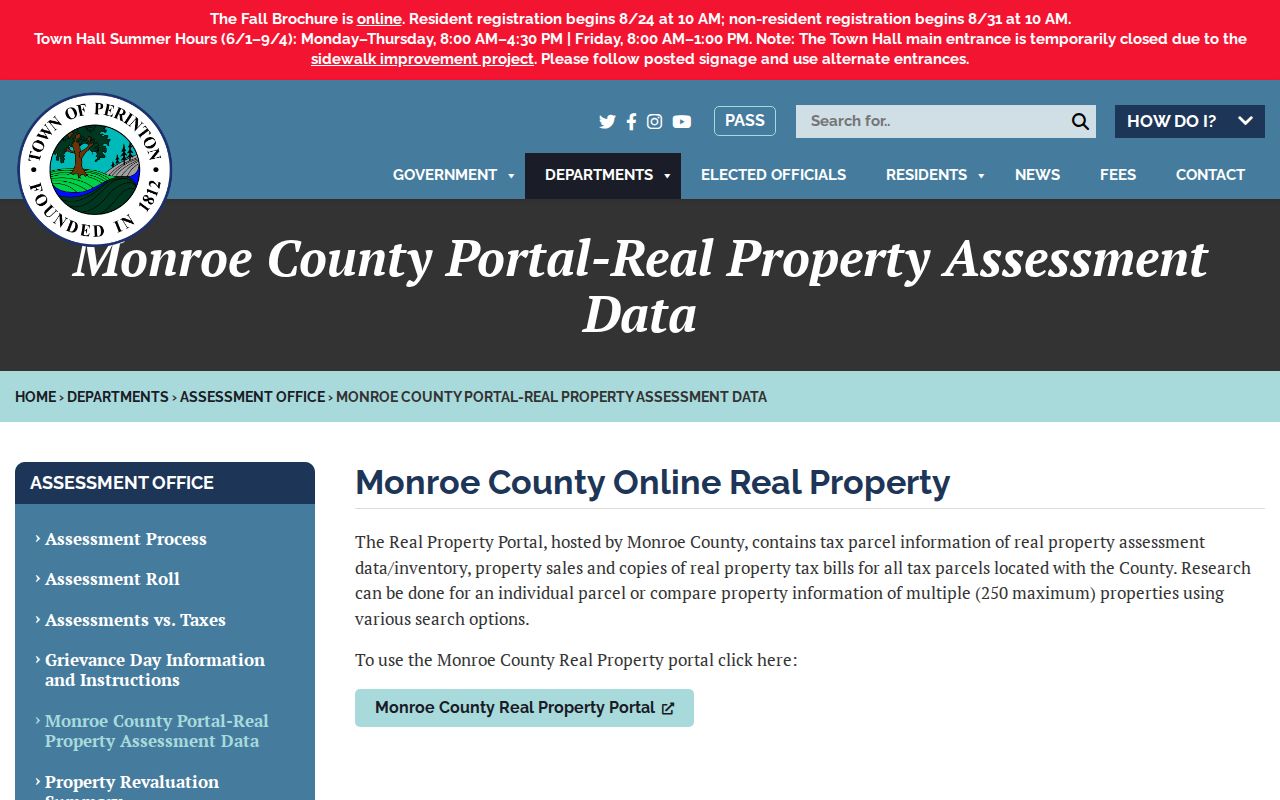
Use the returned parcel ID and roll date as the handoff to GIS and deed research, and retain the distinction between a property location and any owner mailing address.
Perinton Parcels and Deed Trails
The Monroe County Parcel Viewer lets a researcher identify a subject polygon, adjacent parcels, roads, and boundary layers. It is a map and orientation tool, not a household register. A parcel edge or aerial layer can clarify which lot is under review, while a recorded deed or survey answers a legal-description question. For a street-by-street sequence, the focused Perinton street directory route keeps the address chain in one place.
The next handoff is the Clerk index. Record grantor, grantee, recording date, document type, book or page reference, and property description. The County’s historical guidance sends researchers to microfilm for pre-1975 deeds, while a County historian page describes online transactions from February 1984 forward. Those official statements do not provide one settled digital cutoff, so confirm coverage before expecting a remote image.
Beginning April 1, 2026, guests may search and view County Clerk indexing in IQS, while remote document images require a paid subscription. The public terminals continue to provide full indexing and images without a subscription. That change affects access, not the evidentiary value of an instrument. Mail, fax, telephone, and counter copy routes remain alternatives when an online image is unavailable.
The Monroe County Clerk records page is shown below. Its index and copy routes support a date-labeled deed trail rather than a broad search for names.
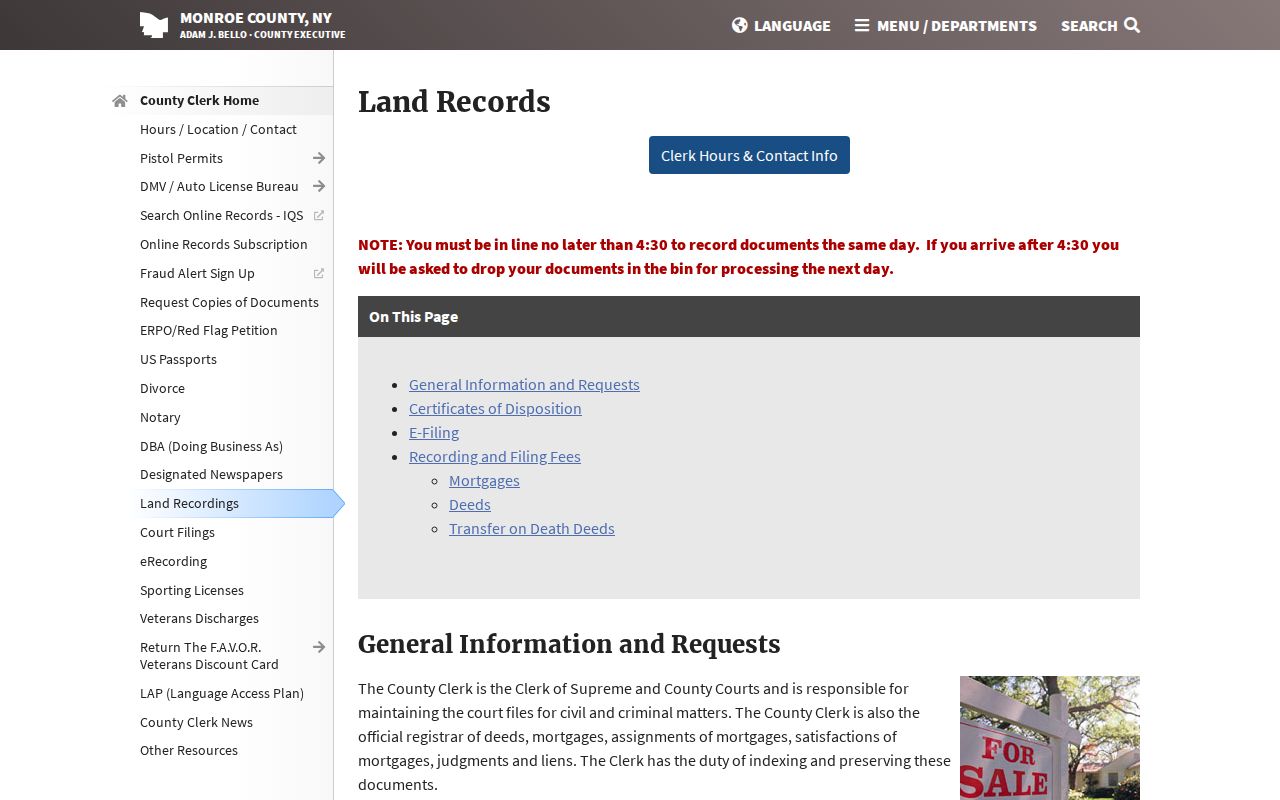
A deed can establish a legal transfer. It still needs a directory, obituary, permit, or other dated source before it is used to describe a historical household.
Current Perinton Residents Directory Sources
Current Perinton directory sources are narrow by design. They show ownership, registration, a public office, or an official status rather than all people living on a street. Use the source that answers the question, then retain its limits. The best check often pairs two different public systems instead of repeating the same name search.
| Perinton source | What a result can show | Custodian | Access channel |
|---|---|---|---|
| Assessment roll and property report | Parcel owner, mailing field, situs, class, value, and parcel references | Perinton and Monroe County | Town roll, County portal, or assessor office |
| Recorded land index | Deed parties, recording details, and legal description | Monroe County Clerk | IQS, terminal, phone, mail, fax, or counter |
| Voter lookup | A searched registration, polling, ballot, and elected-official result | Monroe County Board of Elections | Specific online lookup or Board route |
| GovWell permit history | Address-linked permit, inspection, and completion information where public | Perinton Building and Codes | Portal, department contact, or Town FOIL |
| Official license or business record | Regulatory or entity affiliation | New York State agency | State search or written custodian route |
A name in a property result should be checked against the parcel, a recorded deed, or a distinct dated source. A civic result should be read only for its stated category. The Perinton resident lookup workflow is designed for that one-person verification task instead of a whole-street question.
Perinton Voter Lookup Limits
Monroe County’s voter tool is an address-and-name verification service, not a Perinton residents directory. Its fields are street number, selected street name, ZIP Code, last name, and date of birth in the required format. Results cover voter registration, Election Day polling place, sample ballot, absentee or mail-in ballot status, and elected officials. A missing result can reflect a move, spelling or apartment difference, nonregistration, protected status, or another county.
Election Law allows supervised inspection of registration records while protecting driver-license numbers, non-driver IDs, Social Security numbers, and certain images. A data-file request has its own election-purpose rule and the County fee sheet lists a $25 data-request fee. Confidential voter registration under Election Law §5-508 can separate a record from public inspection for four years. Do not use a parcel, map, or old directory to try to reconstruct a protected address.
Monroe County’s voter lookup appears below. It shows the precise fields that make it useful for checking one supplied identity, not for browsing a street.
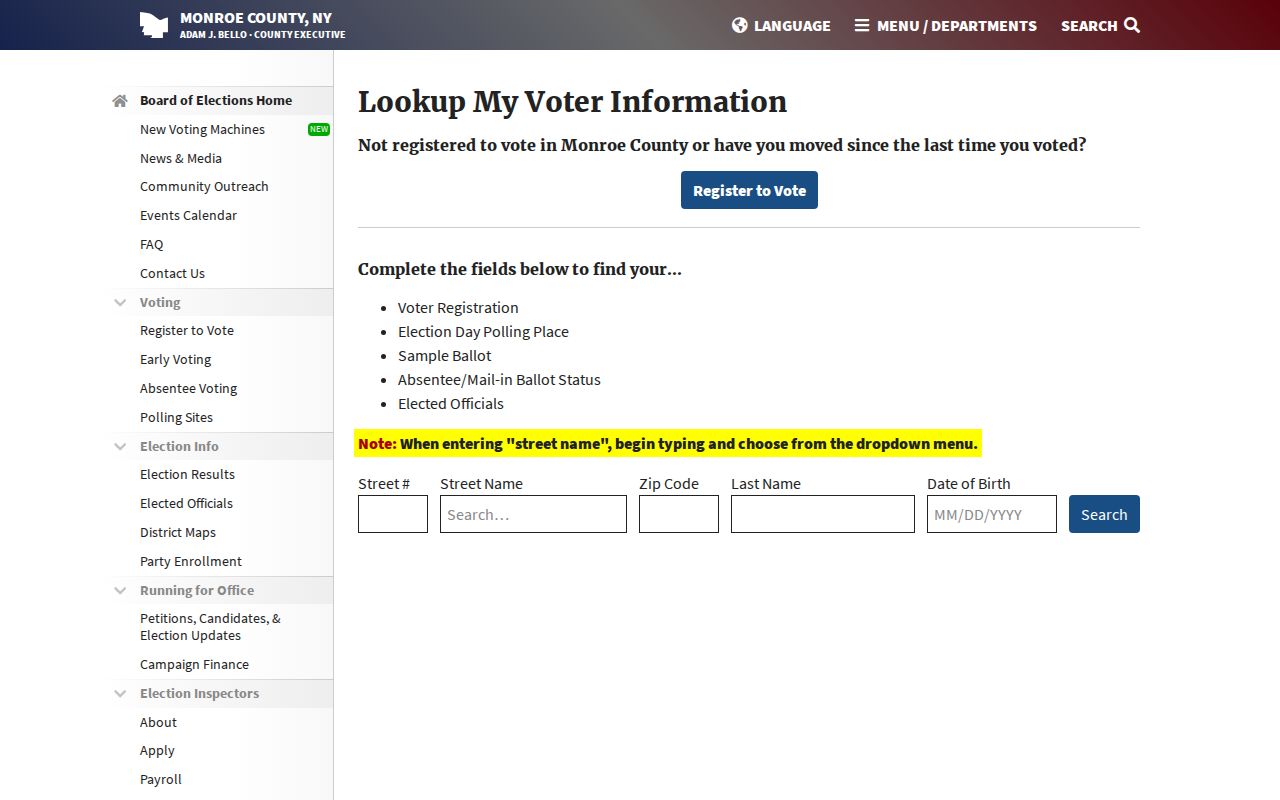
When a result appears, save the query date and result category. Do not republish the date-of-birth search key or treat one voter result as proof of everyone at an address.
Perinton FOIL Request Routes
New York’s Freedom of Information Law is Public Officers Law Article 6. It is a way to request an existing record that an agency can reasonably identify, not a way to require a new resident spreadsheet or an answer to a research question. Perinton’s FOIL form asks for requested records and requester contact details. It also has fields for a denial or exemption decision, which helps if a request must be narrowed or appealed.
State guidance generally calls for an agency to grant, deny, or acknowledge a request within five business days and provide an estimated date when more time is needed. Perinton says readily available records are provided within 20 days or less, otherwise an estimate is supplied. Inspection or photographing can be free, while standard letter or legal black-and-white copies are normally 25 cents a page. Privacy, investigative, and other statutory exemptions can still apply.
Use Perinton’s FOIL route for Town-held material, the County Records Access Officer for County records, and the particular court or vital-record custodian for records governed by separate rules. A narrow date, street, parcel, or record-series request is more workable than a request for everything about a person.
Historical Perinton Residents Directories
Perinton’s historical trail is unusually local. Fairport Public Library points researchers across its own material, Town Historian files, Perinton Historical Society holdings, and Rochester Public Library resources. The library holds local-history files, yearbooks, and digitized newspaper access. The Historian’s files include streets, ownership, cemeteries, census material, obituaries, maps, photographs, and local government material. These are dated clues, best checked against a deed or a second contemporary source.
Central Library Local History and Genealogy holds Rochester city directories from 1827 and suburban directories from 1930. Digitized Rochester volumes include 1885, 1890, 1899, 1905, 1910, 1915, 1922, and 1925. The 1885 Monroe County directory is especially helpful because its Perinton section identifies householders, land held or leased, post-office locations, and town officers. It also uses the localities Fairport, Egypt, and Bushnell’s Basin.
The fuller Perinton directory book treatment explains the different shelves, volumes, and access limits. A historical listing shows a person or household at one point in time. It does not update a modern address and should not be read as a present-day contact record.
Perinton’s 1813 Document Index
The local Town Document Index covers material from 1813 through 1890 and is a useful start for names that predate later printed directories. It was created in a 1939-1941 project sponsored by the Perinton Historical Society and Town Board, and remains a finding aid at Fairport Public Library. The index is evidence that an early record may exist, not a substitute for reading the original document or confirming custody.
Perinton was established in 1812, and Fairport was incorporated as a village in 1867. Those dates explain why older records can describe a locality, post office, village, or town differently. Search Fairport, Egypt, Bushnell’s Basin, street, and county together when an early item lacks the modern label. The Town Historian, Historical Society, County Clerk, and library collections each preserve a different part of that record history.
Note: A historic locality name can improve a search, but a modern parcel should still be confirmed through the municipality and legal description.
Perinton Record Access Changes
Local access is changing in ways that affect a research log. Perinton’s GovWell permit system launched March 26, 2025 and advertises permit history from 1988 forward, with tools for applications, corrections, notes, payments, inspections, and completion certificates. Some detail can have privacy or account limits. Older paper material and current digital workflow may therefore require different requests to Building and Codes.
The Town’s 2026 revaluation began in 2025, following its prior 2018 revaluation. A final roll should be read with its year because assessment values, names, and parcel descriptions are snapshots. The County Clerk’s April 2026 image-access change similarly means a researcher should state whether an instrument image came from a public terminal, a subscription, a clerk copy, or index metadata only.
These access dates make a Perinton residents directory more useful when they are recorded with the result. They also keep a future searcher from assuming a visible portal worked the same way in another year.
Perinton Privacy Boundaries
A careful Perinton search stops at protected records. The New York Address Confidentiality Program can provide eligible participants with a substitute mailing address and mail forwarding. Confidential voters are protected through a separate election-law process. Vital records have age, relationship, and identification rules, and court, adoption, juvenile, sealed, and victim-identifying records can have their own restrictions. A public tax map does not override any of those safeguards.
Official records are stronger than broad compiled people-finder products because their custodian, date, and scope are visible. They are also limited. Assessment data is not a household list, a voter tool is not a street browser, and a business or license location is not proof of a residence. Where an official record does not answer the question, ask the custodian about its lawful request process rather than combining fragments to fill a private gap.